
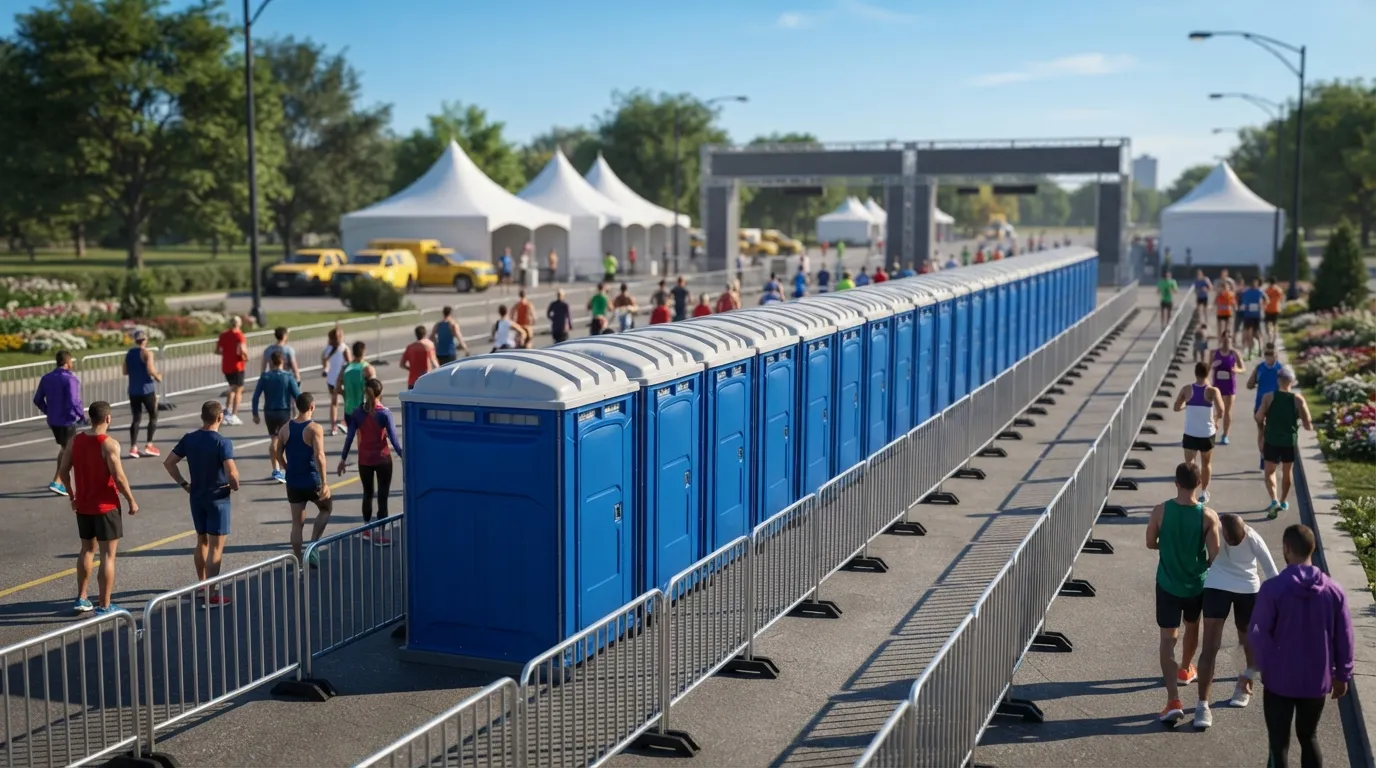
How Many Restrooms Does a Race Course Need?
Runners do not queue the way a static crowd does. They pass in waves, so you need restrooms spread the length of the course, not stacked at one point. How many porta potties do I need covers ratios, but for races the rule of thumb is different: think per aid station, not per total headcount. A typical Tamiami half marathon spreads six to ten standard units across water stops, with a heavier cluster at the start line where everyone shows up at once. OSHA 1926.51(c) sets construction toilet ratios by worker count, and while a race is not a job site, that same logic of matching fixtures to peak crowding applies at the corrals. Add at least one ADA accessible unit per cluster; ADA Standards section 213.2 requires 5 percent of clustered single-user units to be accessible, never fewer than one. Finish-line crowds are the real test. Spectators linger, runners cramp up and need a place fast, and medical tents need water nearby under OSHA 1926.51(a)(1), which calls for an adequate potable water supply at the place of work. Race organizers running through Sweetwater, 3.1 miles northeast of Tamiami, or Westchester, 4.4 miles east, often split rental orders across two pickup points to cut drive time for the service truck.
What Does a Race Course Restroom Setup Cost?
Race restroom pricing runs by the day or the weekend, since most events wrap in a single morning. A standard unit rented for a single event day lands in the same band as any day rental, but races often need weekend coverage for setup and breakdown.
| unit | day | weekend |
|---|---|---|
| standard | $100 - $350 | $125 - $400 |
| ada | $200 - $400 | $199 - $300 |
| deluxe | $85 - $1200 | $150 - $290 (week rate shown) |
Delivery fees run separately and depend on how many stops the driver makes across the course. See porta potty rental cost for a fuller breakdown, or porta potty rental per day if your event is a single-day race. Races with an expo or a beer garden the night before often add a deluxe flushable unit for VIP staff. If your course also needs lighting at pre-dawn start corrals, a light tower rental pairs with restroom placement, and both need a power source. If you are running a generator or a temporary power pole for timing equipment and medical tents, brace it properly: guy-wire or ballast the pole base so wind and foot traffic near a crowded corral do not tip it, and keep cabling clear of the runner lane entirely. OSHA 1926.404(b)(1)(ii) requires GFCI protection on construction-site power, a good baseline standard even for temporary race power. Knowing how to brace a temporary power pole matters just as much as the electrical hookup: set the base on firm, level ground, guy-wire it at two or three points away from the runner lane, and add ballast or stakes so a gust or a jostling crowd near the corral cannot walk it over.
Where Should Restrooms Go Along the Course?
Placement matters more than count. Units belong on firm, level ground with a clear path in from the course, not wedged behind a fence where a runner has to detour. ADA Standards section 302.1 calls for stable, firm, slip-resistant surfaces, and section 405.2 caps ramp slope at 1:12 if you are bridging a curb or grass verge. Keep a 36 inch clear route per ADA Standards section 403.5.1 from the course edge to the unit, and make sure the door swings on a 32 inch clear opening under section 404.2.3. For sprawling festival-style finish areas, our porta potty placement guide walks through sightlines and drainage. If your race runs near Kendale Lakes, 4.6 miles south of Tamiami, or out toward Westwood Lakes, 4.9 miles southeast, factor extra drive time into your delivery window since our trucks stage from central Tamiami. Larger races sometimes bring in a restroom trailer for staff and elite athletes instead of standard units; the 4 stall restroom trailer works well for a finish-line VIP area. Whatever you place, order handwashing stations alongside every restroom cluster. 29 CFR 1910.141(d)(2) requires soap and towels or a hand-drying device at wash stations, not sanitizer alone, and aid stations handling gels and sports drink spills benefit from real handwashing more than a squirt bottle.
How far in advance should I book race restrooms?
Book four to six weeks out for a race with road closures, since permitting and route logistics take time. Smaller fun runs can book two weeks out. Confirm placement in the public right of way with the City, since that approval process is not something we can verify without your specific route.
Do I need an ADA unit even for a small 5K?
Yes. ADA Standards section 213.2 requires at least one accessible unit per cluster, and a small race still counts as a cluster if you have any restrooms at all. Skipping it is the most common compliance miss we see with first-time race directors in Tamiami.
Can restrooms be moved mid-race for a rolling closure?
Units can be repositioned between waves, but plan the move window carefully. A restroom trailer cannot be relocated quickly; standard units can be shifted by hand truck once the corral clears.
What size tank do aid-station units carry?
Standard units carry a 60 to 70 gallon holding tank, enough for a busy aid station across a single morning without a mid-event pump-out.
Should I rent extra units for the expo the day before?
Yes, if your expo draws a crowd. Add standard units for expo day separately from race-day units, since monthly porta potty rental or multi-day pricing may cost less than two separate day orders.
Next step
Get a delivery date
Tell us the address, the dates and the headcount. We size the order and confirm the route.